
The Panda British Guiana Postmark Catalog
(1831 – 22 Jan 1901)
By Paul A. Ramsaroop in collaboration with the Guyana Philatelic Society.
I am compiling a comprehensive catalog of British Guiana date-stamps used on pre-adhesive envelopes from the colony’s formation in 1831—when Essequibo, Demerara, and Berbice were unified—through the issuance of adhesive stamps beginning in 1850, and concluding at the end of Queen Victoria’s reign on January 22, 1901.
This catalog aims to provide the most accurate chronological overview possible of the various postmarks employed during this period, serving as a valuable resource for philatelists and historians interested in the postal history of British Guiana.
In addition to cataloging the postmarks, we will assign a rarity classification based on their scarcity using the following codes:
- (E) Exclusive (1-10 examples known)
- (R) Rare (11-20 examples known)
- (S) Scarce (21-30 examples known)
- (U) Uncommon (31-50 examples known)
- (C) Common (51+ examples known)
If sufficient data is available for a postmark, we will assign it a catalog value to reflect its philatelic significance. This value will be based on sales data from auctions, online platforms, and other market sources, providing a more accurate understanding of each postmark’s rarity and demand.
We will primarily use the nomenclature Nx.y-z for identifying and categorizing the types of postmarks.
N represents the category:
- A: Demerara and Berbice hand-stamps used on pre-adhesive envelopes.
- B: Early Berbice and Demerara Circular Date-Stamps.
- C: Coded Postmarks.
- D: Early Georgetown and New Amsterdam Date-Stamps.
- E: Date Stamps from late 1877 to 22 January 1901 (the end of Queen Victoria’s reign).
x is a sequential number differentiating the types of date-stamps (e.g., Type 1, 2, 3…).
y is a sequential number to differentiate the different postmarks within the type, typically distinguishing the post offices.
z is an additional sequential number when necessary to differentiate cases where multiple offices use the same type and postmark or other distinguishing factors. In such instances, z may also extend to include a letter for codes on the postmark, with an additional sequential number to account for multiple factors within the same code letter. If no code is present, “n” will be used to indicate no-code.
One of the advantages of creating a virtual catalog is that I don’t have to face the common dilemma of choosing whether to display postmarks by Type or by Post Office—a decision that often challenges collectors. In this virtual format, we can overcome that limitation by presenting the postmarks in both ways, offering a comprehensive display organized by Postmark Type as well as by Post Office. This dual approach enhances the catalog’s value, allowing users to explore the postmarks from multiple perspectives and making it a more versatile resource.
Please note that as this is a work in progress, types may be added or removed hereby renumbering the types until the project is complete.
Abbreviations
C.D.S. – Circular date-stamp
D.R. – Double Ring
L.D. – Line Date
L.F. – Large Font
S.R. – Single Ring
Y.A. – Year Abbreviated
Y.I.F. – Year in Full
References
To accomplish these tasks, we will rely heavily on the most excellent works done on this subject to date:
- The Postage Stamps and Postal History of British Guiana by Townsend & Howe, Published by The Royal Philatelic Society, London in 1970. Edition limited to 500 copies for sale. (see cover photo below)
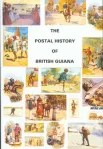
- The Postal History of British Guiana by Edward B. Proud. Published by Proud Bailey Co Ltd. in 2000. (see cover photo below)
- British Guiana Village Postmarks: An Update on Townsend & Howe by Peter Ford published in the British West Indies Study Circle (BWISC) Bulletin No. 199, December 2003
- British Guiana Coded Postmarks – Study paper No 3 by Michael Rego. Published by BWISC in 2010. (see cover photo below)


A family link ...
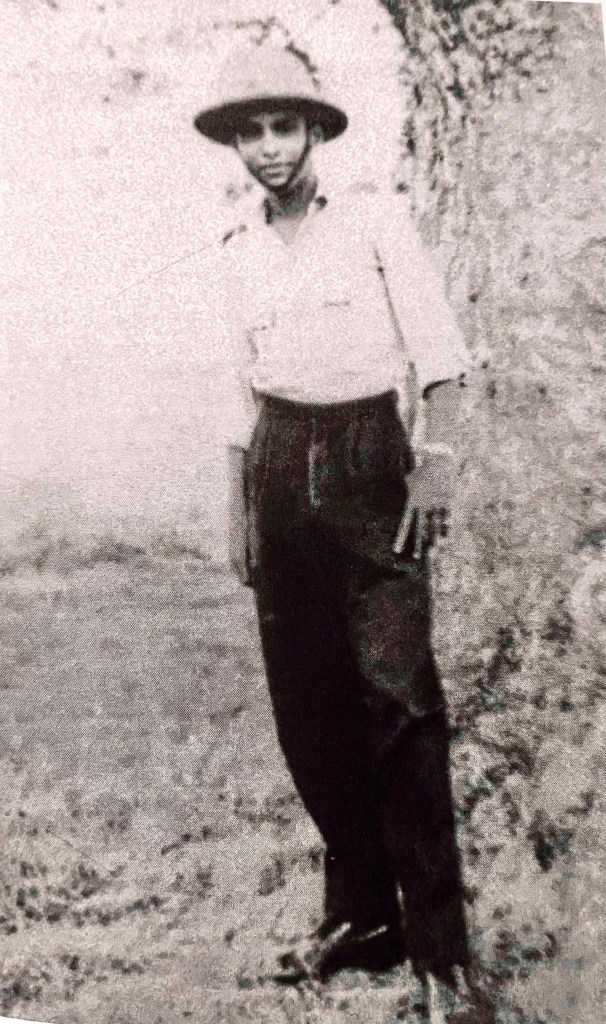
To show off my smart Postal Apprentice outfit the government decided that my first posting, as a sophisticated Georgetown boy, should be to Skeldon Post Office, over 100 miles away, at the south eastern end of the coast road from Georgetown. For me it appeared to be the back of beyond, the other end of the country, on the west bank of the Corentyne River bordering Surinam. I lived alone in a very large creepy house, overlooking the Corentyne River, which I obtained for a small rent as it was not being used.
… I took to the posting like a duck to water. I enjoyed post office counter duties, learning the tricks of the postal trade, weighing parcels and letters, selling postal orders and stamps and the da dit, da da dit, of sending and receiving Morse code messages. I rode around the area on my new attractive bicycle with white walled tyres, which had a loud tick tick sound attracting welcome attention.
In addition to post office counter duties I delivered telegrams, to places such as 63 village (with a beach reputed to the be best in the country) and Crabwood Creek – the last stretch of made up road on the coast, the home of several sawmills, beyond which lay the interior of the country. Although these places were only five miles from Skeldon Post Office, cycling there and back in the heat or through torrential rains, in full uniform, were tasks which I never looked forward to.
(excerpt from Recycling a Son of the British Raj by Peter Ramrayka, 2015)
Acknowledgements …
Thank you to Ann Wood, President of The Guyana Philatelic Society, and Charles Kennard for their invaluable contributions to this endeavor. I am forever grateful to the late Simon Goldblatt and the late Charles Freeland, whose influence guided me from solely collecting British Guiana stamps into the broader and richer exploration of its postal history. Through this project, I hope to carry forward their extensive knowledge for future generations. Special thanks to Michael Hamilton for generously sharing his data, and to Richard Maisel, the late Michael Medlicott, and the late Peter Ford for their patient and thoughtful responses to my many questions. Lastly, to the late Derek Nathan, though I did not have the pleasure of knowing you, your work on British Guiana’s postal history was the inspiration behind this project. This acknowledgment would not be complete without paying homage to the foundational works of Michael Rego, the late Edward B. Proud, the late F.G. Howe, and the late W.A. Townsend.

